|
|
The history of the United
States Park Police is intrinsically linked with the formative
years of our Nation's Capital. Following a mandate from
Congress, President Washington appointed the first board of
trustees, called "commissioners,” in 1791. These three
commissioners implemented plans for the development of a new
district at the confluence of the Eastern Branch (Anacostia) and
the Potomac River that would become the seat of government for
the United States. In addition to providing suitable buildings
for Congress, the president, and other departments within the
government, they were responsible for the protection and care of
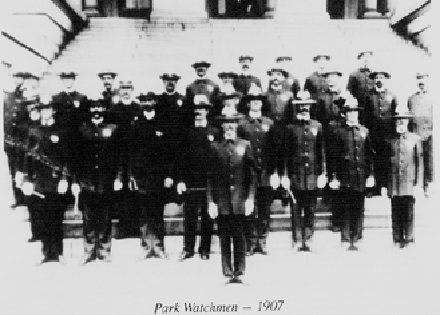
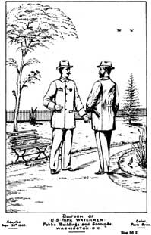
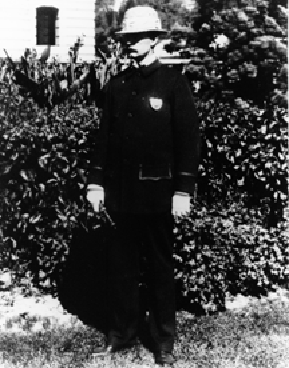
all public property. To this end, watchmen were hired to
safeguard the newly acquired public buildings and grounds.
Inasmuch as the National Park Service is legal successor to the
original commissioners' office with respect to national capital
parks function, the United States Park Police can likewise trace
their functional lineage to the early watchmen.
In 1802, the office of the
Federal Commissioners was abolished and their duties conferred
upon a Superintendent of Public Buildings and Public Grounds. In
1816, the responsibilities of the superintendent were
transferred to one commissioner who reported directly to the
president.
There
was initially one watchman on duty at the Executive Mansion,
later to become known as the White House, and one at the Capitol
Building. The first watchman at the Capitol for which we have a
name was John Golding, appointed in 1801 with an annual salary
of $371.75. Golding, as well as his immediate successors, had no
authority to make arrests. On
occasion, the lone guard relied on local
marines for assistance when they confronted intruders or other
difficult situations.
1827, the number of watchmen at the
Capitol was expanded to four (4). By an Act of Congress one (1) year later,
the watchmen at the U.S. Capitol became separate and distinct
from those under the direction of the Commissioner of Public
Buildings, reporting instead to the presiding officers of the
House and Senate.
The Interior Department was
created in 1849 and assumed control over the park system of the
Nation's Capital until 1867, when this responsibility was passed
to the Chief Engineer of the United States Army. During the
military's tenure, oversight of day‑to‑day operations was
delegated to an active duty officer, normally a major or
colonel. His responsibilities as the officer in charge of Public
Buildings and Grounds included supervision of the park watchmen.
The Force at that time was comprised of 2 watchmen assigned to
the Executive Mansion, 5 at the Smithsonian Grounds (the
Smithsonian "castle" building having been constructed between
1847 and 1857), and 1 at Franklin Square.
This office was replaced in
1925 by a new and independent agency, Public Buildings and
Public Parks of the National Capital, headed by a director who
once more reported directly to the president. One of the 3
directors to hold that position was Lieutenant Colonel Ulysses
S. Grant, III, grandson of the celebrated Civil War general and
18" President of the United States.
The office of Public
Buildings and Public Parks of the National Capital was absorbed
by the newly designated Office of National Parks, Buildings and
Reservations. A year later, this cumbersome name reverted back
to the "National Park Service," an agency within the Department
of the Interior. The Park Police were once again employees of
Interior, their predecessors having held that distinction
between 1849 and 1867. This is the organizational umbrella under
which the U. S. Park Police remain to this day.
|